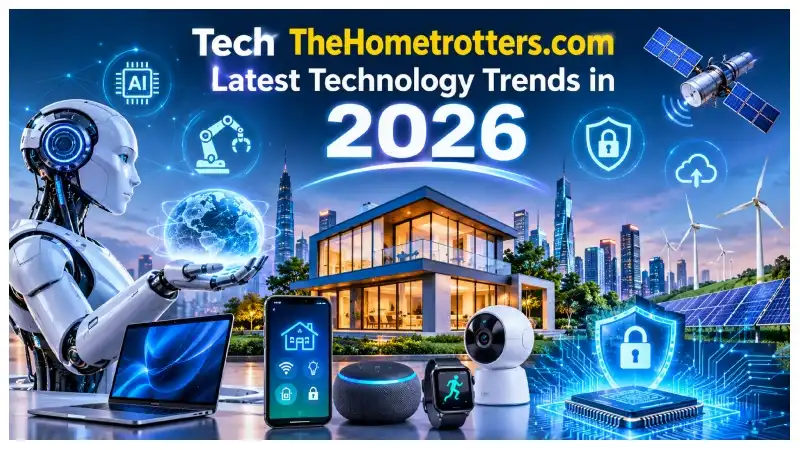
Technology continues to change how people work, communicate, shop, travel, and manage their daily lives. In 2026, innovation is moving beyond smartphones and traditional computer systems. Artificial intelligence, intelligent robots, advanced cybersecurity, connected devices, and powerful computing systems are creating new opportunities across different industries.Businesses are finding smarter ways to serve customers, while individuals are gaining access to tools that once seemed futuristic. However, not every new invention delivers real value. Understanding which developments solve practical problems can help people make better decisions about technology.At Tech TheHometrotters.com, our focus is on exploring these developments and explaining how they affect everyday life. This guide covers the latest technology trends in 2026, their practical applications, potential benefits, and challenges worth understanding.
1. Artificial Intelligence Is Becoming More Independent
Artificial intelligence (AI) remains one of the biggest technology trends in 2026. Earlier AI tools mainly answered questions, generated text, or analysed information. Newer systems can handle more complex tasks and coordinate several steps with less human input.
One important development is agentic AI. These systems, known as AI agents, can understand goals, plan actions, use supported software tools, and complete tasks within defined limits.
For example, a business might use an AI agent to organise customer enquiries, identify common problems, prepare responses, and send complicated cases to human staff. Tech TheHometrotters.com can reduce repetitive work and give employees more time for important decisions.
AI also supports healthcare research, software development, financial analysis, and customer service.
However, greater independence creates new risks. AI agents can make mistakes, misunderstand instructions, or access information they should not handle. Human supervision, clear permissions, and regular testing remain essential.
2. Robotics and Physical AI Are Advancing
Robotics is becoming more intelligent as developers combine traditional machines with modern AI systems. Tech TheHometrotters.com development is often called physical AI because intelligent software helps machines understand and interact with the physical world.
Factories already use robots for repetitive manufacturing tasks. Newer systems are developing better abilities to recognise objects, respond to changing conditions, and work alongside people.
For example, a warehouse robot can identify packages, move inventory, and adjust its movements when workers or other machines enter its path.
Robotics also has potential applications in agriculture, healthcare, logistics, and home assistance. Agricultural robots can help monitor crops, while specialised machines can support certain medical and rehabilitation tasks.
Although these developments are promising, robots still face challenges involving cost, safety, maintenance, and reliability. Their usefulness depends on the environment and the task they perform.
3. Cybersecurity Is Becoming More Important
As more devices and services connect to the internet, protecting personal and business information becomes increasingly important.
Cybercriminals use different methods to steal passwords, spread malicious software, impersonate trusted organisations, and access private information. AI has also made it easier to create convincing fraudulent messages and impersonation attempts.
In response, cybersecurity companies are developing more advanced detection and prevention systems.
Some important developments include:
- AI-powered threat detection: Identifies unusual activity and potential security risks.
- Passkeys: Provide an alternative to traditional password-based sign-ins.
- Multi-factor authentication: Adds another verification step when accessing accounts.
- Confidential computing: Helps protect sensitive information while systems process it.
- Automated security monitoring: Helps organisations identify suspicious behaviour more quickly.
For ordinary users, simple habits remain valuable. Use unique passwords, enable two-factor authentication, install software updates, and avoid opening unexpected links.
Technology can improve security, but responsible digital behaviour remains equally important.
4. AI-Powered Software Development Is Changing Programming
Software development is also experiencing a major transformation. AI coding assistants can help developers write code, explain unfamiliar functions, identify errors, and generate initial versions of applications.
In 2026, AI-native development platforms are attracting attention because they allow development teams to integrate AI throughout the software creation process.
For example, a small business might use AI-assisted development to create a basic booking application or an internal inventory tool. Developers can then review, test, and improve the generated code.
These tools can reduce the time needed for routine programming work. They may also help beginners understand technical concepts.
However, AI-generated code is not automatically reliable. It can contain security weaknesses, incorrect logic, or outdated methods. Developers must still test applications, check dependencies, and review important decisions.
The most effective approach combines AI assistance with human knowledge and careful quality control.
5. Quantum Computing Is Moving Towards Practical Research
Quantum computing is another important area of technological development. Unlike traditional computers, which process information using bits, quantum computers use quantum bits, or qubits.
Qubits behave according to the principles of quantum mechanics. Tech TheHometrotters.com allows quantum systems to approach certain specialised problems differently from conventional computers.
Researchers are exploring possible applications in:
- Materials science.
- Chemical and drug discovery.
- Complex scientific simulations.
- Optimisation problems.
- Advanced computing research.
For instance, scientists may eventually use quantum computing to investigate complex chemical interactions that are difficult to simulate using conventional methods.
However, quantum computing is not a replacement for everyday laptops or smartphones. Current systems face significant challenges, including errors, stability, and hardware complexity.
Its practical impact will depend on continued scientific progress and the development of useful applications.
6. Smart Connectivity and the Internet of Things
The Internet of Things (IoT) connects physical devices so they can collect, exchange, and respond to information.
Smart homes provide a familiar example. Connected lights, security cameras, thermostats, and appliances allow people to manage household activities through compatible applications.
Businesses also use connected sensors to monitor equipment, track inventory, and manage operations.
Another important development is Matter, a smart home connectivity standard designed to improve communication between compatible devices from different manufacturers. Thread also supports communication between connected devices through low-power mesh networking.
These technologies can make connected environments easier to manage.
For example, a homeowner could create an automation that switches off selected lights when everyone leaves the house.
Still, buyers should check product compatibility, internet requirements, privacy settings, and long-term support before investing in connected equipment.
7. Energy Technology Is Supporting the AI Revolution
Modern technology requires considerable computing power. AI data centres, cloud platforms, and advanced computer chips all depend on reliable electricity and effective cooling systems.
As demand increases, energy efficiency is becoming a major technology priority.
Companies are exploring better data centre cooling, advanced batteries, renewable energy systems, and smarter electricity management.
AI can also support energy networks by analysing consumption patterns and helping operators manage supply and demand.
For example, a smart electricity system could use demand forecasts to help balance power distribution during periods of high consumption.
These improvements matter because technological progress must also address its environmental and infrastructure costs.
The future of digital innovation will depend not only on faster processors but also on the energy systems that support them.
8. Satellite Connectivity Is Expanding Digital Access
Internet connectivity remains limited in some remote and underserved areas. Satellite communication offers another way to connect people and businesses where traditional infrastructure is difficult to build.
Modern satellite networks are developing services that can provide broadband access and support communication in locations with limited terrestrial coverage.
Direct-to-device satellite communication is also an important area of development. It aims to connect compatible mobile devices with satellites in supported situations.
Potential applications include emergency communication, remote travel, maritime services, and connectivity in rural communities.
However, coverage, device compatibility, network capacity, and service availability vary between providers.
Satellite services are not a universal replacement for mobile networks, but they can provide useful additional coverage.
9. Digital Provenance and Trustworthy Technology
As AI-generated text, images, audio, and video become more common, identifying the origin of digital information is increasingly important.
Digital provenance refers to information that helps establish where digital content came from and how it has changed.
For example, content credentials can provide details about an image’s creation or editing history when creators and platforms use compatible systems.
Tech TheHometrotters.com technology can help journalists, publishers, businesses, and consumers assess digital material.
However, provenance information does not automatically prove that content is truthful. It is one part of a wider verification process that should also include reliable sources and independent checks.
Building digital trust will remain an important challenge as synthetic media becomes more sophisticated.
10. How to Keep Up With Technology Trends in 2026
Following every new invention can become overwhelming. A better approach is to focus on developments that have practical value.
Here are five useful habits:
- Follow reliable technology publications: Read research reports and updates from recognised organisations.
- Learn essential AI skills: Understand how AI tools work and where human judgement remains necessary.
- Improve digital security: Keep your accounts, devices, and applications protected.
- Explore useful innovations: Test technologies that solve genuine personal or professional problems.
- Check information before sharing: Verify major technology claims instead of trusting every online headline.
At Tech TheHometrotters.com, exploring technology through practical explanations can help readers understand not just what is new, but why it matters.
Frequently Asked Questions
1. What is the biggest technology trend in 2026?
Artificial intelligence is one of the most influential technology trends in 2026. AI agents, advanced computing infrastructure, and AI-powered automation are changing how businesses and individuals complete tasks.
2. How is AI changing everyday life?
AI helps people write, research, organise information, translate languages, and automate routine activities. Its usefulness depends on the quality of the tool and how responsibly people use it.
3. Will robots replace human workers?
Robots may automate certain repetitive or physically demanding tasks. However, many jobs still require human judgement, creativity, communication, and problem-solving. The impact will differ across industries.
4. Is quantum computing useful today?
Quantum computing remains an emerging field. Researchers are exploring specialised applications, but conventional computers remain the practical choice for most everyday tasks.
5. Why is cybersecurity important in 2026?
More personal information and business activities depend on connected systems. Strong cybersecurity helps protect accounts, financial information, private communications, and digital services.
6. What technology skills should beginners learn?
Beginners can start with AI literacy, basic cybersecurity, digital communication, data handling, and problem-solving. These skills provide a useful foundation for understanding modern technology.
Conclusion
The latest technology trends in 2026 show how quickly digital innovation is moving into everyday activities and real-world industries. Artificial intelligence, robotics, cybersecurity, quantum research, smart connectivity, and energy technology are creating new possibilities.
However, adopting every new development is not necessary. People and businesses should focus on technologies that offer genuine benefits, provide reliable performance, and protect their information.
Understanding both opportunities and limitations makes it easier to make informed decisions. Through practical technology coverage and accessible explanations, Tech TheHometrotters.com aims to help readers stay informed about innovations shaping the digital world.For more information visit our site daily.