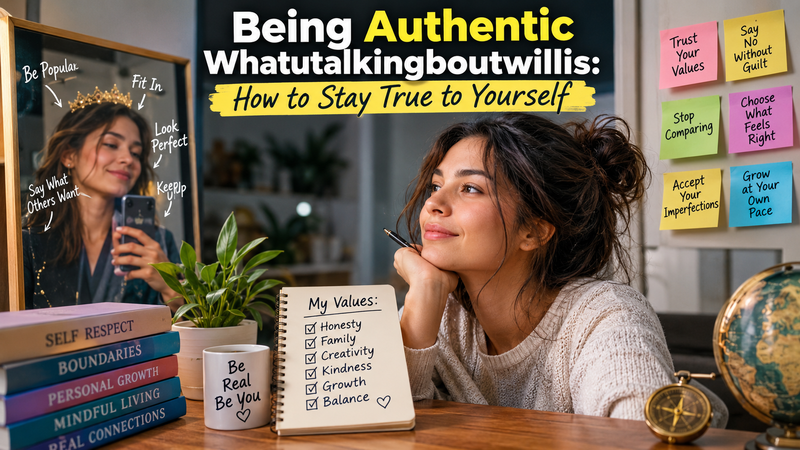
In a world filled with social expectations, online personas, and pressure to fit in, being yourself can sometimes feel surprisingly difficult. You may change the way you speak around certain people, hide your opinions to avoid conflict, or compare your life with carefully edited images online. Authenticity offers another way. It means living in a way that reflects your genuine values, feelings, beliefs, and personality rather than constantly trying to become the person others expect you to be. But Being Authentic Whatutalkingboutwillis does not mean saying everything that comes to mind or refusing to grow. It means knowing who you are, making honest choices, and allowing your actions to reflect what matters to you.
What Does Being Authentic Really Mean?
Being Authentic Whatutalkingboutwillis means acting in alignment with your values and accepting yourself without creating a false version of who you are to gain approval.
An authentic person can still learn, change, apologise, and adapt. The difference is that these changes come from personal growth rather than pressure to please everyone else.
For example, imagine someone who dislikes large social gatherings but regularly attends them because they worry that friends will think they are boring. Choosing a quieter activity instead does not make that person antisocial. It may simply reflect what genuinely makes them comfortable.
Authenticity starts with recognising the difference between who you are and who you think you are supposed to be.
Why Is Authenticity Important?
Living authentically can make everyday decisions simpler. When your choices reflect your values, you spend less energy maintaining an image that does not feel natural.
Authenticity can also strengthen relationships. People generally find it easier to build meaningful connections when they understand what someone genuinely thinks and feels. You do not need to impress everyone to create relationships that matter.
There is also an important connection between authenticity and self-respect. When you repeatedly ignore your needs or compromise your values just to receive approval, resentment and frustration can build over time.
Being authentic does not guarantee an easy life. However, it can help you create a life that feels more like your own.
Signs You May Not Be Living as Your True Self
Everyone adjusts their behaviour in different situations. That is normal. The problem begins when adapting becomes a constant habit of hiding yourself.
You might be struggling with authenticity if you:
- Frequently worry about what other people think of you
- Say yes when you actually want to say no
- Hide your opinions to avoid disappointing others
- Change your personality depending on who you are with
- Compare your life constantly with people online
- Feel exhausted after trying to maintain a certain image
- Make major decisions mainly to gain approval
- Struggle to identify what you personally want
None of these signs automatically mean that you are being dishonest. They can simply be signals worth exploring.
Ask yourself: “If I knew nobody would judge me, what would I choose?”
Your answer may reveal something important about your genuine preferences.
How to Become More Authentic
Authenticity develops through small, consistent choices. You do not need to completely change your personality overnight.
1. Identify Your Core Values
Start by asking what genuinely matters to you.
Your values might include honesty, family, independence, creativity, kindness, learning, stability, adventure, or fairness.
Choose three to five values that feel most important. Then look at your daily life.
Are your choices consistent with those values?
For example, if family is one of your strongest values but your schedule leaves no time for the people you care about, you may need to reconsider your priorities.
Values become useful when they influence your actions.
2. Learn to Say No
One of the simplest ways to practise authenticity is to set healthier boundaries.
You do not need a dramatic explanation every time you decline something. A simple, respectful response can be enough:
“Thank you for asking, but I won’t be able to do that.”
At first, saying no may feel uncomfortable, especially if you are used to pleasing people. With practice, you can learn that disappointing someone occasionally does not make you a bad person.
A healthy boundary protects your time and energy while still respecting other people.
3. Stop Comparing Your Behind-the-Scenes With Someone Else’s Highlight Reel
Social media makes comparison almost effortless. You see someone’s achievement, holiday, relationship, home, or career success without seeing the ordinary moments surrounding it.
Instead of asking, “Why isn’t my life like theirs?”, ask:
“Does their version of success actually match what I want?”
That question shifts your attention from imitation to self-awareness.
Your ideal life does not have to look impressive to someone else. It needs to make sense for you.
4. Notice When You Are Seeking Approval
Wanting approval is human. The goal is not to stop caring what anyone thinks.
Instead, notice when approval becomes the main reason behind your decisions.
Before making an important choice, ask:
- Would I still choose this if nobody praised me?
- Am I doing this because I want it or because I fear rejection?
- Does this decision fit my values?
- Will I respect myself for making this choice later?
These questions can create enough distance to make a more honest decision.
5. Accept Your Imperfections
Authenticity does not require perfection.
You can be confident and still feel insecure sometimes. You can care deeply about people and still need personal space. You can make mistakes while genuinely trying to do better.
Trying to appear flawless often creates more pressure than simply admitting that you are human.
Self-acceptance does not mean refusing to improve. It means recognising your current reality without treating every weakness as a reason to dislike yourself.
Being Authentic at Work
Professional environments naturally require some adjustment. You may communicate differently with a manager than you do with a close friend, and that is perfectly normal.
However, professionalism should not require you to create a completely false identity.
Suppose you have a creative idea during a meeting but remain silent because you are afraid someone might disagree. Sharing the idea respectfully allows your real perspective to contribute.
You can also be authentic by acknowledging uncertainty.
Instead of pretending to know everything, you might say, “I’m not sure yet, but I’ll look into it.”
Honesty combined with professionalism often creates greater trust than pretending to have all the answers.
Being Authentic in Relationships
Being Authentic Whatutalkingboutwillis relationships allow people to know each other beyond carefully managed appearances.
This can mean expressing your preferences, communicating your needs, and discussing problems rather than pretending everything is fine.
For example, if you always agree with your partner about how to spend your free time despite having different interests, frustration may eventually appear. A healthier approach could be to communicate honestly and find a compromise.
Authenticity should work both ways. Being yourself does not give you permission to dismiss another person’s feelings. Genuine connection requires honesty and respect.
What Authenticity Is Not
There are a few common misconceptions about being authentic.
Authenticity is not bluntness. Saying something hurtful and calling it “just being honest” does not make it authentic or considerate.
Authenticity is not selfishness. Your needs matter, but other people’s needs matter too.
Authenticity is not refusing to change. Personal growth often requires changing habits, beliefs, or behaviours.
Authenticity is not oversharing. You can be genuine while maintaining privacy and healthy boundaries.
Real authenticity combines self-awareness with responsibility.
A Simple Daily Practice for Authentic Living
You can strengthen your sense of self with a five-minute reflection at the end of each day.
Write down three things:
- When did I feel most like myself today?
- When did I hide or change myself to gain approval?
- What is one small choice I can make differently tomorrow?
Do this consistently for a few weeks. Patterns may become easier to recognise.
Perhaps you notice that you feel most like yourself when creating something, spending time outdoors, having meaningful conversations, or working independently. Those observations can help you understand what genuinely energises you.
The Courage to Be Yourself
Being Authentic Whatutalkingboutwillis is not about becoming a completely different person. It is often about removing the layers of expectation that have accumulated over time.
You may discover that some goals were never truly yours. Some relationships may need stronger boundaries. Some habits may have developed simply because you wanted acceptance.
That realisation can feel uncomfortable, but it can also be freeing.
The goal is not to make everyone understand or approve of you. The goal is to build enough self-awareness and confidence to make choices that reflect who you are and what you value.
Being Authentic Whatutalkingboutwillisis ultimately a practice, not a personality trait. Start small. Tell the truth when it matters. Set a boundary when you need one. Choose what genuinely fits your values. Admit when you are wrong. Allow yourself to grow.
You do not need to perform a perfect version of yourself.
You only need to become more honest about the person you already are.
For more information visit our site daily.